 | ||
 Shopping
Cart Shopping
Cart | ||
Login  New Member Registration | ||
| My Library | ||
| ||
|
| ||

This site utilizes the following free downloads: -Macromedia Flash -mp3 player -WinZip  |










 |
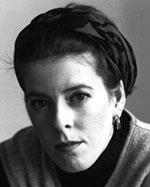 Jill
Battson: Moving from Page to Stage and Beyond Jill
Battson: Moving from Page to Stage and Beyond Canadian poet Jill Battson was born in England and has lived in the U.S. and Canada. A former art director and filmmaker, Battson was the program coordinator for the Poet's Refuge reading series; producer of the Word Up! series (videos on MuchMusic, compilation CD with Virgin Records and an anthology published by Key Porter); the Canadian poetry organizer for Lollapalooza; and organizer of the "Poetry Express," a poets and playwrights reading series at the Fringe Festival of Toronto. In 1996 she visited Malawi, in Africa, the result of which became an online journal. She is a former Slam team champion and has been published extensively. Battson is currently working with the Taos Poetry Circus in Taos, New Mexico. Listen to Jill Battson read her work.
Well, it's certainly not conducive to a rousing performance! After I finished my first book Hard Candy, I thought—well at least I can write some less depressing poems now. Then both of my parents died, and I knew my next book was going to be about them. It's taken me a long time to write these pieces too. There was a stage of about a year where I was too depressed to write any poems at all. I had visualized a book that would be solely about their passing—much like Sharon Olds' book The Father, but, and I know this sounds a little clinical, I didn't get as many poems out of their deaths as I thought I would, so I shaped the book to be about loss and the ongoing recovery from loss. Now I'm wondering how I am going to perform these pieces because they are so dark. Not that much of my work isn't. And to answer your question about how difficult it is to publish this kind of work: I tend to write the piece and then by the time it has gone through a few edits, a few open mic performances, the piece detaches itself from me and goes out into the world and I almost feel that is not about me anymore. But ... I haven't read a lot of these poems in performance, so we'll see what happens!
I guess 'multimedia' poet means that I work in a variety of genres. When I started writing poetry, abut ten years ago, I thought it was important to perform my work live. After all, it might be years before I got published. Performing is also an immediate way to get your words across without mediation. Of course I'm always looking for ways to reach more people with my work, and that's really why I started working in other mediums. The Word Up project started as an idea for creating a series of poetry videos of my own work to air on MuchMusic.
What do you see in electronic media that allows you to express yourself in a way that cannot be done on paper? Well, it certainly is accessible to more people, especially since people are reading traditional books less and less, and it probably reaches a different audience. I assume we're talking electronic in terms of web and CDs. A site which has your recorded voice or image is bound to give the poem more kick, more life, since the audience is seeing the poem performed in the way the poet intended—that is providing the poet didn't intend for the poem only to be read by a reader, therefore giving the reader the opportunity to 'hear' it in their own way.
No, I don't think it is a novelty that will burn itself out. It seems that poetry is always on a ten year cycle of popularity. All of a sudden you'll see poetry in print ads, commercials and the media will write about it like it's the next coolest thing, then it becomes passe for them. Some may say that all this activity attracts a whole bunch of new poets, which may or may not be good. But there is a new generation of poets that grew up with electronic media and can use it to their gain. I also think it's a wise move for the older generation to embrace whatever medium there is to disseminate their work. I think the immediacy of slam and performance certainly makes poetry more entertaining, gives it less of a high brow, boring image. There are complaints that Slam, originally conceived to bring poetry to the stage, is becoming more commercial, moving farther away from its original conception. As a former member of a championship Slam team, do you think slam is getting way out of line, or following its due course? I think the slam was originally conceived to bring unmediated poetry to the stage, and in that way it is very successful. But the work one hears at the slam is all very similar—broadly speaking, either social commentary or comedy—which I find disappointing and frankly, rather tedious. I can imagine that if the range of poems performed at slams was increased, the slam would be a very interesting place to be. However, since the judges are generally made up of audience members, and the audience itself came to see poetry as entertainment, and theatrical presentations of social commentary or comedy are very entertaining, in that they impact and engage the emotions of the audience I can't see that the content will change that much. The slam is a great place to get noticed though, and there are lots of success stories and can be if the poet is willing to evolve, or if they are actually able to write more than one poem. —Tod McCoy, PublishingOnline |
 ashes are bone and
dust
ashes are bone and
dust Hard Candy